In today’s job market, submitting a resume doesn’t mean a human will read it.
Before your resume reaches a recruiter, it usually passes through an Applicant Tracking System (ATS) — software powered by automation and, increasingly, artificial intelligence.
If you’ve ever wondered:
“Why am I not getting calls?”
“My ATS score is 85+, but still no response?”
“Do recruiters even read resumes?”
This guide explains how modern ATS systems actually work.
What Is an Applicant Tracking System (ATS)?
An Applicant Tracking System (ATS) is recruitment software used by companies to:
- Collect applications
- Filter resumes
- Rank candidates
- Track hiring workflow
Popular ATS platforms include:
- Workday
- Greenhouse
- Lever
- Taleo
Large enterprises and even mid-sized startups use these systems to handle thousands of applications.
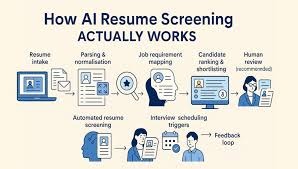
How ATS Systems Actually Work (Step-by-Step)
Let’s break it down.
1 Resume Parsing
When you upload your resume:
- The ATS scans the document.
- Extracts text.
- Identifies sections (Skills, Experience, Education).
- Converts everything into structured data.
⚠ If your formatting is messy (tables, images, columns), parsing can fail.
2 Keyword Matching
This is where most candidates misunderstand ATS.
Recruiters create a job description like:
“Node.js developer with PostgreSQL, REST APIs, and Docker experience.”
The ATS searches for:
- Exact keyword matches
- Synonyms
- Skill frequency
- Context relevance
For example:
“Node.js” ≠ “Node”
“Postgres” ≠ “PostgreSQL” (sometimes)
Modern AI-based ATS can understand context better, but keyword alignment still matters heavily.
3 Ranking & Scoring
The system then ranks candidates based on:
- Keyword match percentage
- Years of experience
- Location relevance
- Education filters
- Employment gaps
Your resume might not be rejected — it might just be ranked lower.
If 500 people apply and 50 score higher, you won’t get seen.
4 AI-Based Screening (The New Layer)
Newer ATS systems integrate AI models to:
- Evaluate skill relevance
- Predict job fit
- Analyze career progression
- Detect exaggeration patterns
- Flag inconsistent timelines
Some platforms now use AI to:
- Summarize your profile
- Compare you to top-performing employees
- Assess communication clarity
This means resumes are no longer just keyword documents — they are evaluated for quality and logic.
Common Myths About ATS
Myth 1: “If I get 90% ATS score, I’m safe.”
Not true. ATS score tools online are simulations — real ATS systems vary by company.
Myth 2: “Fancy design resumes are better.”
Wrong. Clean, simple formatting works best.
Myth 3: “More keywords = better ranking.”
Overstuffing keywords can reduce credibility and even trigger flags.
How to Optimize Your Resume for ATS (Smart Way)
Here’s what actually works:
Mirror the Job Description
If the job says:
“RESTful API development”
Use:
“Developed RESTful APIs”
Exact alignment improves ranking.
Use Clear Headings
- Professional Summary
- Technical Skills
- Work Experience
- Projects
- Education
Avoid creative names like:
“My Journey”
“What I Know”
Add Measurable Impact
Instead of:
Built backend APIs
Write:
Built REST APIs handling 5K+ monthly requests and reduced response time by 30%.
Numbers improve ranking and human trust.
Remove Formatting Errors
- Avoid multiple columns
- Avoid icons inside section headers
- Use standard fonts
Final Reality Check
ATS is not your enemy.
It’s a filter.
The real challenge is: Standing out among 1000 applicants with similar skills.
The real game is:
- Positioning
- Specialization
- Clear backend strength
- Networking + referrals