
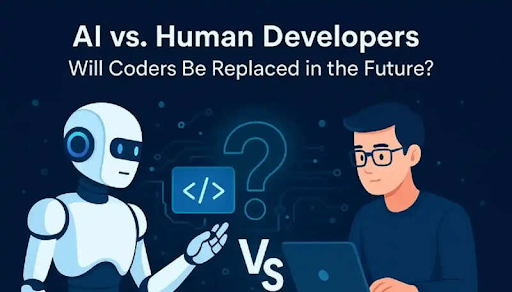
The debate around AI vs human developers is no longer theoretical. By 2026, AI has moved from “coding assistant” to active collaborator, raising a serious question:
Will AI replace developers, or redefine what it means to be one?
The short answer: coding in 2026 is no longer about typing code it’s about directing intelligence.
Let’s break it down.
The Evolution of Coding: From Syntax to Strategy
Then (Before AI)
- Developers wrote every line manually
- Debugging took hours
- Boilerplate code was unavoidable
- Speed depended entirely on human effort
Now (2026 Reality)
- AI writes 60–80% of boilerplate code
- Developers focus on:
- Architecture
- Business logic
- Security
- Performance
- Architecture
- Coding is faster, cleaner, and more intent-driven
Coding has shifted from “how to write code” to “what to build and why.”
What AI Developers Can Do in 2026
AI tools in 2026 are far more advanced than early copilots.
AI Capabilities in 2026
- Generate full applications from prompts
- Refactor legacy code automatically
- Detect security vulnerabilities
- Optimize performance in real time
- Write tests, documentation, and APIs
- Translate natural language → production code
Examples
- “Build a GST invoice generator for India”
- “Optimize this app for 2s load time”
- “Convert this React app to Next.js”
AI executes. Fast.
What Human Developers Still Do Better (And Always Will)
Despite the hype, AI has clear limitations.
Human Strengths AI Cannot Replace
- Product thinking – understanding users
- Business context – why features matter
- Ethical judgment – privacy, fairness, compliance
- Creative problem-solving
- System architecture decisions
- Trade-off evaluation
AI can write code.
Humans decide what code should exist.