Software development has always evolved from low-level programming to frameworks, from monoliths to microservices.
But in 2026, the shift driven by generative AI is different.
This isn’t just a faster way to write code.
It’s a fundamental change in how software is designed, built, tested, and maintained.
From Writing Code to Directing It
For decades, developers spent most of their time:
- Writing boilerplate
- Debugging syntax issues
- Searching documentation
In 2026, generative AI handles much of that.
Developers now:
- Describe intent instead of implementation
- Focus on architecture and logic
- Act more like system designers than code typists
AI generates:
- Functions
- APIs
- Database queries
- UI components
Human effort shifts upward — from how to write code to what to build and why.
AI as a Real-Time Coding Partner
Modern AI tools don’t just autocomplete lines — they:
- Understand full codebases
- Suggest refactors across files
- Detect logical flaws, not just syntax errors
In 2026, it’s common for developers to:
- Ask AI to explain legacy code
- Generate tests for existing features
- Refactor performance bottlenecks
This dramatically reduces onboarding time and technical debt.
Faster Prototyping, Shorter MVP Cycles
What once took weeks now takes days.
Startups use generative AI to:
- Spin up MVPs quickly
- Validate ideas before heavy investment
- Iterate based on user feedback in near-real time
This has lowered the barrier to entry for building software —
ideas matter more than execution speed alone.
The Rise of AI-Assisted Architecture
In 2026, AI helps with:
- Choosing tech stacks
- Designing scalable architectures
- Suggesting cost-efficient cloud setups
Instead of guessing, developers can simulate decisions:
“What happens if this app scales to 1 million users?”
AI provides tradeoffs, not just answers — making architectural decisions more informed.
Testing, Debugging, and Maintenance Are No Longer Afterthoughts
Generative AI excels at:
- Writing unit and integration tests
- Finding edge cases humans miss
- Predicting failure points
Bug fixing becomes:
- Faster
- Less reactive
- More preventive
Maintenance shifts from firefighting to continuous improvement.
Documentation Finally Catches Up
In the past, documentation was:
- Outdated
- Incomplete
- Ignored
In 2026, AI generates:
- Live documentation from code
- API references automatically
- Onboarding guides for new developers
This improves collaboration and reduces knowledge silos.
How Developer Roles Are Changing
Generative AI hasn’t replaced developers —
it has redefined them.
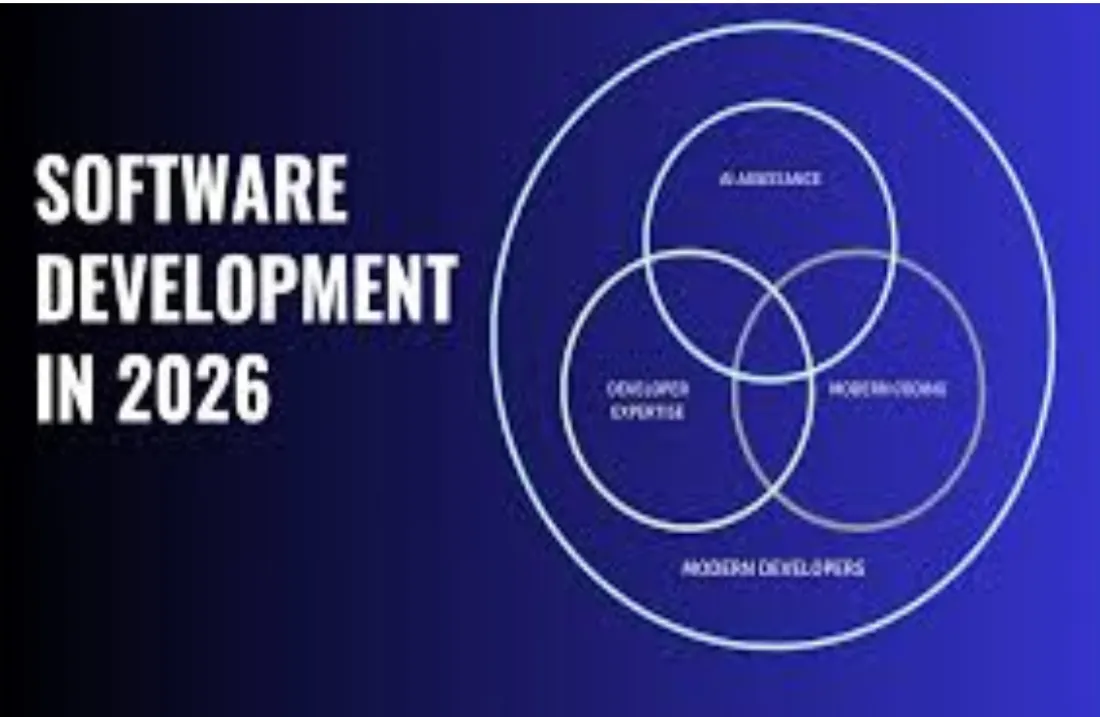
Modern developers need:
- Strong system thinking
- Product understanding
- Prompting and evaluation skills
- Ethical and security awareness
Junior developers ramp up faster.
Senior developers focus more on decision-making and mentorship.
Security & Responsibility Matter More Than Ever
With AI generating large parts of code:
- Security reviews become critical
- Human oversight is non-negotiable
- Trust boundaries must be clearly defined
In 2026, good teams don’t ask:
“Can AI write this?”
They ask:
“Should AI write this?”
Challenges That Still Exist
Despite its power, generative AI isn’t perfect:
- It can hallucinate
- It may introduce subtle bugs
- It reflects training data biases
That’s why human judgment remains essential.
AI accelerates development — it doesn’t replace responsibility.
The Bigger Picture
Generative AI isn’t making developers obsolete.
It’s making software creation more accessible, faster, and smarter.
The developers who thrive in 2026 are those who:
- Embrace AI as a collaborator
- Focus on problem-solving over syntax
- Adapt continuously
Software development isn’t disappearing —
it’s evolving.