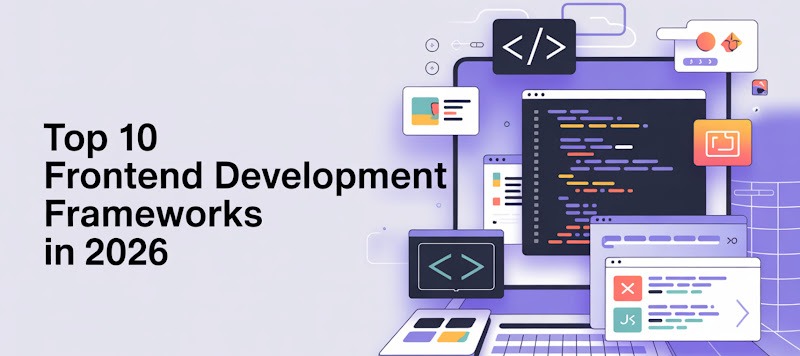
Frontend development has evolved rapidly over the past decade. In 2026, developers have access to powerful frameworks that help build fast, scalable, and highly interactive web applications. Choosing the right framework can significantly improve performance, development speed, and maintainability.
In this article, we will explore the best frontend frameworks in 2026, their advantages, and when you should use them.
1. React — The Most Popular Frontend Library
React continues to dominate frontend development even in 2026. Created by Meta Platforms, React is widely used for building dynamic user interfaces.
Why React Is Popular
- Component-based architecture
- Large developer community
- Huge ecosystem of libraries
- Excellent performance with Virtual DOM
- Easy integration with other tools
Companies Using React
Many leading companies rely on React, including Netflix, Airbnb, and Facebook. React is ideal for single-page applications (SPAs), dashboards, and scalable web apps.
2. Next.js — The Future of React Applications
Next.js has become one of the most powerful frameworks built on top of React. Developed by Vercel, it solves many problems developers face with traditional React apps.
Key Features
- Server-Side Rendering (SSR)
- Static Site Generation (SSG)
- Built-in routing system
- API routes for backend logic
- Excellent SEO optimization
Why Developers Love Next.js
Next.js improves performance and SEO while reducing the need for additional configuration. It is widely used for SaaS platforms, eCommerce websites, and high-performance web apps.
3. Vue.js — Simple and Developer-Friendly
Vue.js is known for its simplicity and flexibility. It has gained popularity among developers who want a lightweight and easy-to-learn framework.
Advantages of Vue
- Easy learning curve
- Reactive data binding
- Lightweight and fast
- Strong documentation
- Flexible architecture
Vue is perfect for small to medium projects and developers who want to build applications quickly.
4. Angular — Enterprise Level Framework
Developed by Google, Angular remains one of the most powerful frameworks for large-scale enterprise applications.
Key Features
- Built-in TypeScript support
- Dependency injection
- Advanced architecture for large apps
- Strong tooling and CLI support
Angular is widely used for enterprise dashboards, banking apps, and large systems.
5. Svelte — The Rising Star of Frontend Development
Svelte is gaining massive attention because it works differently from traditional frameworks. Instead of using a Virtual DOM, Svelte compiles code directly into optimized JavaScript.
Why Developers Like Svelte
- Extremely fast performance
- Less boilerplate code
- Small bundle size
- Easy state management
Svelte is perfect for developers who want high performance with minimal complexity.
6. SolidJS — High-Performance Reactive Framework
SolidJS is another modern framework gaining traction in 2026.
Benefits
- Fine-grained reactivity
- Very fast rendering
- Lightweight architecture
- React-like syntax
It is designed for highly optimized applications and real-time interfaces.
How to Choose the Right Framework
When selecting a frontend framework, consider the following factors:
Project Size
Large enterprise applications benefit from frameworks like Angular, while smaller apps may work better with Vue or Svelte.
Performance Requirements
For high-performance applications, frameworks like Svelte and SolidJS provide excellent speed.
Community Support
Frameworks with large communities, such as React, offer better support, libraries, and resources.
SEO Requirements
For SEO-focused projects, Next.js provides powerful server-side rendering capabilities.
Final Thoughts
Frontend development continues to evolve rapidly. In 2026, frameworks like React, Next.js, Vue, Angular, Svelte, and SolidJS are shaping the future of modern web applications.
For most developers today, React and Next.js dominate the ecosystem, Vue remains the easiest framework to learn, and Svelte and SolidJS are pushing performance boundaries.
Choosing the right framework ultimately depends on your project requirements, team expertise, and scalability needs.